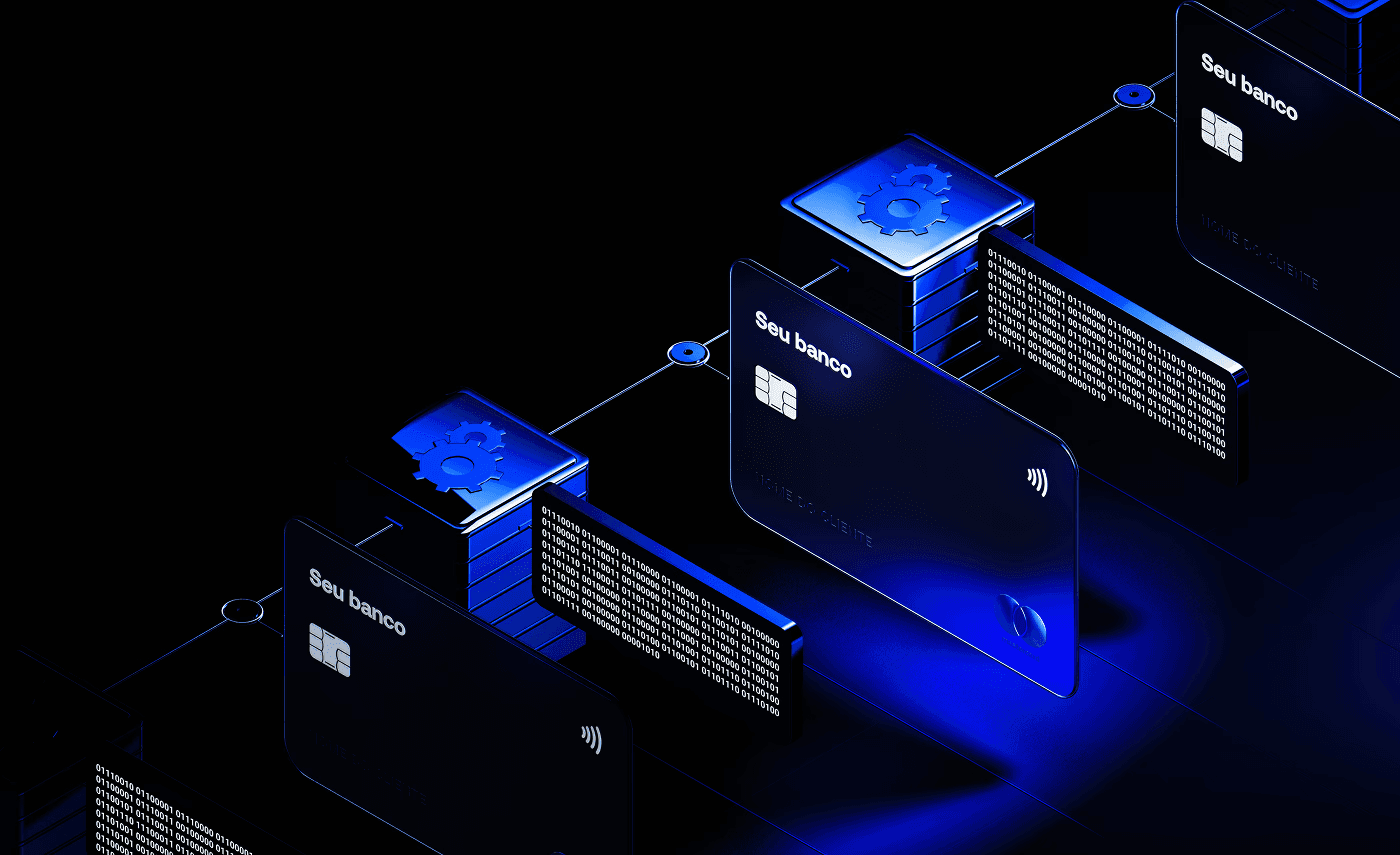
For a long time, cards were seen only as a means of payment — a way to enable transactions within an already established financial ecosystem. But that scenario has changed.
Today, cards have become one of the main monetization tools within digital business models. Fintechs, retailers, mobility platforms and even SaaS companies have started to treat the card not as an add-on, but as a strategic asset.
This movement follows market evolution. According to Abecs, the card sector in Brazil handles more than R$ 3 trillion per year, with consistent growth driven mainly by the use of credit and the digitalization of payments.
Within this volume, there is a simple logic: whoever controls the payment method captures a significant share of the value generated in each transaction.
That is exactly what is driving the adoption of proprietary cards by companies.
From a payment method to a revenue engine
To understand how companies monetize with cards, you first need to change the way this product is perceived.
Cards are not just a payment interface. They are a point for capturing recurring revenue.
Every time a user makes a card transaction, fees are divided among different participants in the ecosystem: the network, issuer, acquirer, among others. Part of this revenue — especially interchange — goes to the card issuer.
Historically, this value was concentrated in banks.
With the rise of models like Banking as a Service and white-label cards, companies began to access this same source of revenue.
This completely changes the monetization logic. Instead of relying exclusively on operating margins or direct sales, the business begins to capture value continuously as the user uses the card.
The role of interchange in monetization
Interchange is the main component of this equation.
It represents a percentage of each card transaction. Although the amount varies according to the card type and segment, it may seem small when viewed in isolation.
The key point is scale.
Companies with an active user base can turn this flow into a meaningful source of recurring revenue. The greater the transaction volume, the greater the financial impact.
This model is especially effective in businesses that already have high usage frequency. Platforms with natural recurrence — such as mobility, delivery, or financial services — can accelerate this effect more easily.
Beyond interchange: other sources of revenue
Although interchange is the main driver, it is not the only one.
Companies that structure their card programs well can leverage other layers of monetization throughout the journey.
One of them is related to operating fees, such as withdrawals, reissuance of a card, or additional services. In some cases, these revenues are secondary, but they contribute to the composition of the results.
Another relevant front is in the credit offering. Models like the secured card allow companies to provide limits in a controlled way, reducing risk and creating a new source of revenue.
There is also an indirect component that tends to have a significant impact: increased use of the platform itself.
By centralizing payments in its own ecosystem, the company increases internal financial flow, which can boost other revenue lines, such as sales, services, or fees on transactions.
The network effect: the more it’s used, the more revenue
One of the most interesting aspects of monetization with cards is the cumulative effect over time.
Unlike models based solely on acquisition, the card becomes stronger with continuous use. As the user incorporates the card into their daily routine, the transaction volume grows organically.
This behavior creates a network effect within the product itself.
Companies that manage to encourage recurring use — whether through convenience, integration, or benefits — increase not only direct revenue, but also the relevance of their ecosystem.
That is why many players treat the card as a central piece of the retention strategy, and not just as a payment channel.
Case studies: how different sectors monetize
The card-based monetization model adapts to different contexts, but follows a common logic: capturing value from the user's financial activity.
Fintechs are the most direct example. By offering digital accounts and cards, they can monetize both through interchange and through additional services, creating a scalable model.
In retail, the card works as an extension of the relationship with the customer. In addition to transaction revenue, it increases purchase frequency and average ticket, directly impacting revenue.
Logistics and mobility companies use cards to manage payments to drivers or partners. In this case, in addition to direct monetization, there are important operational gains, such as expense control and fraud reduction.
In benefits and incentive programs, the card makes it possible to distribute resources more efficiently, while at the same time generating revenue from the use of these amounts.
Why has this model gained traction now
Card monetization is not new. What changed was access.
Until recently, structuring a card program required scale, capital, and regulatory capability — something restricted to large institutions.
With the rise of Banking as a Service, that barrier has fallen.
Today, companies can access complete financial infrastructure without needing to build everything in-house. This includes card issuance, integration with card networks, and operational management.
This movement democratized access to card-based monetization and opened space for new business models.
What differentiates companies that monetize well
Not every company that launches a card is able to capture meaningful value.
The difference usually lies in how the product is integrated into the user experience.
Companies that treat the card as an isolated element tend to have lower adoption. Those that incorporate the card naturally into the product flow are able to increase usage and, consequently, monetization.
Another important factor is the ability to activate the user base. Incentives, simplicity in issuance, and integration with existing features are elements that directly impact the success of the initiative.
In the end, monetization depends not only on the existence of the card, but on how it is used within the ecosystem.
Conclusion
The evolution of the payments market has transformed the card into much more than a means of transaction.
It has become a relevant source of revenue, a retention mechanism, and a way to increase control over the user journey.
With the growth of the Brazilian market and the expansion of Banking as a Service, companies have gained access to this opportunity more simply and quickly.
For businesses that already have an active user base and recurring financial flow, monetization with cards has ceased to be a distant possibility and has become a strategic decision.
Contact us
If you are evaluating how to capture more value from your user base, understanding the role of cards within your strategy can be a competitive differentiator.