
In today's world, companies that wish to remain competitive need to look beyond traditional financial methods. Crypto integration emerges as a practical solution to offer resale of digital assets, accept payments in cryptocurrencies, and connect internal systems to plug-in APIs, without the need to operate directly as an exchange or currency service provider. With this approach, it is possible to expand the customer base, automate financial processes, and create new revenue opportunities, all within a secure regulatory scope.
What is crypto integration for businesses?
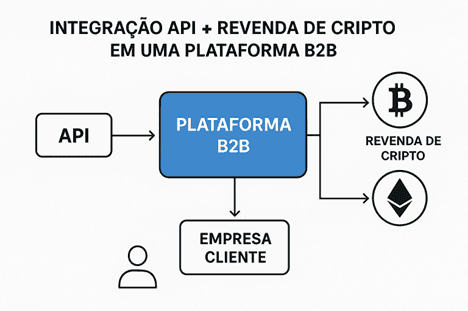
The crypto integration allows companies to connect their financial systems, e-commerce platforms, or applications directly to the world of digital assets. This connection can occur in different ways: resale of digital assets, payments via cryptocurrencies, or pluggable APIs that facilitate asset management and financial transactions.
Unlike traditional solutions, crypto integration offers operational flexibility, allowing businesses to access new markets, automate financial processes, and offer innovative products to customers.
Difference between integration models:
Direct integration: The company operates directly with crypto assets, requiring approvals and complete compliance.
Resale of digital assets: The company acts as an intermediary, offering products from authorized partners, without the need to provide exchange services directly.
Pluggable APIs: Allow existing systems to connect to crypto providers quickly, securely, and scalably.
Informational content. Does not constitute an offer of securities, currency exchange, or payment services. Past performance does not guarantee future results. Azify operates directly or through duly authorized partners.
What are the main benefits of crypto integration for companies?
Modernization: it can also be about opening doors to new opportunities to improve financial efficiency.
Main benefits:
Expansion of revenue opportunities – Companies can resell crypto assets or offer digital financial products, attracting customers interested in innovation and portfolio diversification.
Access to new customers and digital markets – Platforms that accept crypto payments attract a global audience and digital investors looking for ease and speed in transactions.
Automation of payments and financial processes – Pluggable APIs allow for automatic reconciliation of transactions, asset management, and detailed reporting, reducing manual errors and increasing operational efficiency.
Strengthening brand image – Companies that adopt crypto are perceived as innovative and aligned with financial technology trends.
What cryptocurrency integration models can be adopted?
Companies that wish to connect to the world of crypto assets have available various integration models, which vary according to the size of the business, target audience profile, and financial strategy. Each model offers specific advantages, allowing the solution to be tailored to the needs of your business, always within a secure regulatory scope.
1. Resale of digital assets
In this model, the company offers the purchase or sale of crypto assets to customers, but does not operate as an exchange. The authorized partner is responsible for custody, liquidity, and regulatory compliance, while the company focuses on customer experience, sales, and communication.
Example: an e-commerce site can allow customers to acquire gift cards or loyalty points convertible into stablecoins, providing an innovative digital experience without needing its own exchange license. This approach also reduces operational risks, as all regulatory aspects are managed by the authorized partner.
Key benefit: enables companies to explore the crypto market safely and scalably, without increasing their direct exposure to regulatory risks.
2. Payments via cryptocurrencies
Accepting cryptocurrencies as a form of payment opens doors to new customers and international markets. Additionally, it reduces transaction costs and speeds up settlement, especially when the company uses pluggable APIs to automate conversion and recording of transactions.
Simplified crypto payment flow:
Customer makes payment in bitcoin or stablecoin.
Authorized partner's API automatically converts the amount to the local currency.
System generates immediate confirmation and records the transaction in the company's ERP or financial system.
Key benefit: minimizes exposure to volatility and ensures that financial operations are reliable, fast, and integrated into the company's internal processes.
3. Pluggable APIs for integration into existing platforms
Pluggable APIs allow management systems, e-commerce platforms, or financial applications to quickly connect to crypto providers, without the need for major adjustments.
Main advantages:
Agile implementation: significantly reduces the time required to connect systems to the crypto market.
Scalability: easily adapts to increased transaction volume or service expansion.
Built-in compliance: authorized partners already ensure regulatory compliance, reducing legal and operational risks.
Example: a fintech can integrate pluggable APIs to allow customers to make payments, receive earnings in stablecoins, and make internal transfers, all controlled by a single, secure, and auditable platform.
Best practice tip: before adopting any model, assess the profile of your audience, the level of technological maturity of your company, and the regulatory compliance of the partner. This ensures that the crypto integration is efficient, safe, and aligned with the business strategy.
How are companies already applying crypto integration in practice?
Several use cases show how crypto integration can transform businesses in different sectors:
E-commerce and marketplaces: acceptance of stablecoins for international purchases, reducing fees and transfer times.
Fintechs and financial apps: resale of digital assets and integrated wallets via pluggable APIs, offering new investment products to customers.
B2B platforms: automatic payments between companies using crypto, with automated financial reconciliation.
For example, a Brazilian fintech implemented pluggable APIs to enable payments in USDT and Bitcoin. Result: 20% reduction in international transaction costs and a 15% increase in the digital customer base within six months.
What are the best practices and security precautions in crypto integration?
Integrating crypto requires attention to technical and regulatory aspects to ensure reliability and protection of the business.
Recommended best practices:
Choose reliable and authorized partners – Verify licenses, SLAs, and compliance history. Avoid operating directly without authorization.
Regulatory compliance – Pay attention to the rules of regulatory bodies, especially for financial data and KYC/AML/CFT.
Operational security – Protect API keys, implement continuous monitoring, periodic audits, and alerts for suspicious transactions.
Automation and traceability – Use APIs that allow detailed recording of each transaction, facilitating internal and external audits.
Informative content. Does not constitute an offer of securities, foreign exchange or payment services. Past profitability does not guarantee future results. Azify operates directly or through duly authorized partners, as per the scope. Assess risks, accounting impacts, and tax implications with your advisors.
What trends indicate the future of crypto integration for companies?
The crypto integration market is experiencing rapid expansion, driven by factors such as increasing corporate demand, technological innovations in APIs, and a clearer regulatory landscape. These trends not only broaden business opportunities but also transform the way companies interact with the digital financial ecosystem.
Growth of reselling and corporate payments – Companies are seeking agile alternatives to enter the crypto market without the need for their own licensing. Reselling models of digital assets and acceptance of payments in cryptocurrencies have proven effective, allowing businesses to integrate crypto solutions in a simplified and regulated manner.
Smarter plugable APIs – The development of more sophisticated APIs has facilitated the integration of cryptocurrencies into existing platforms, such as ERPs, e-commerce, and digital wallets. These APIs offer advanced functionalities, such as payment automation, asset management, and regulatory compliance, enabling large-scale adoption with security and efficiency.
Innovation in stablecoins and corporate tokens – The issuance of stablecoins and corporate tokens has provided new forms of digital liquidity for companies, reducing reliance on traditional intermediaries. These innovations offer greater control over financial transactions and open doors to new business models, such as asset tokenization and the implementation of smart contracts.
Institutional adoption and regulatory convergence – The integration between the traditional financial system and the crypto market is intensifying. Financial institutions are establishing partnerships with crypto platforms, allowing clients to link bank accounts to digital wallets and conduct transactions with cryptocurrencies. Furthermore, regulatory milestones such as MiCA in Europe and the advancement of regulation in Brazil are creating a safer and more transparent environment for companies operating in the crypto sector.
Sustainability and regenerative finance (ReFi) – The growing concern for sustainability has led to the emergence of regenerative finance (ReFi) projects that use blockchain technology to fund ecological restoration initiatives. These projects not only contribute to environmental preservation but also offer new investment and engagement opportunities for companies looking to align their business with sustainable practices.
A crypto integration represents a concrete opportunity for companies to increase their revenues, access new markets, and automate financial processes. Whether through reselling digital assets, accepting payments in cryptocurrencies, or integrating plugable APIs, it is essential for companies to adopt best practices for security, regulatory compliance, and choose authorized partners to ensure successful and sustainable implementation.